Write-offs vs write-downs: how law firms lose profit
September 18, 2026
·
6 min read
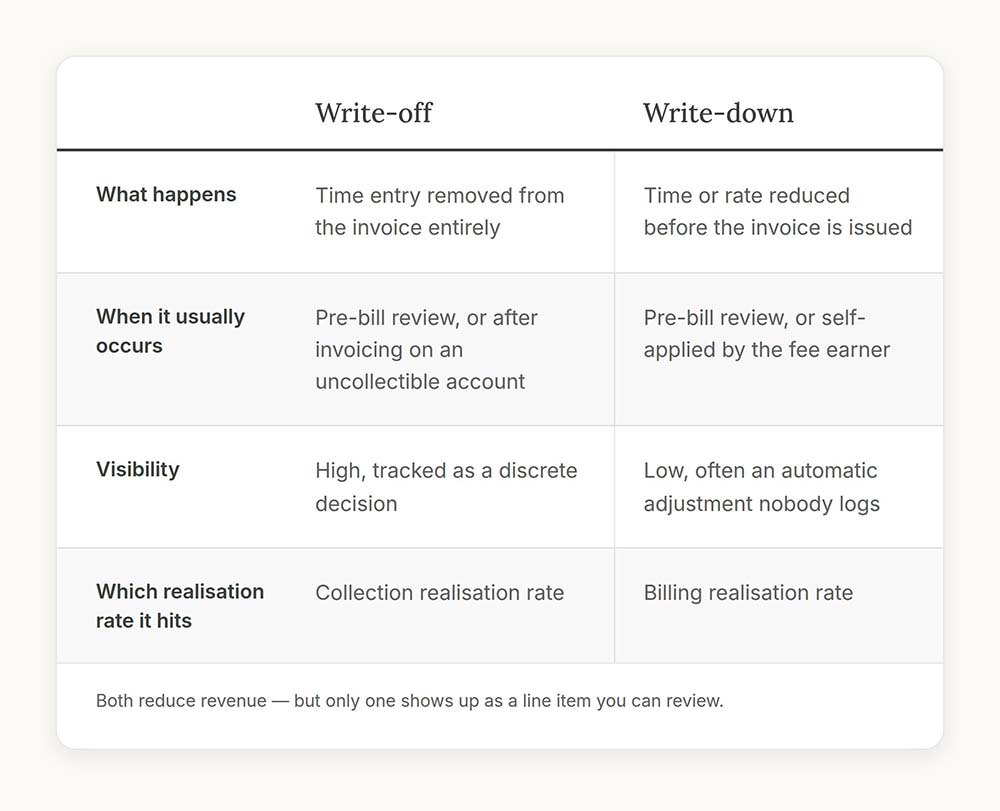
A write-off removes billed or unbilled time completely, so the client never sees it. A write-down reduces the time or value before the invoice is sent, meaning only part of the work is billed. Both reduce the revenue a law firm earns.
While write-offs are usually tracked, write-downs often happen during pre-bill review without much visibility. That makes them one of the easiest ways for revenue to slip away unnoticed.
Many firms focus on winning new clients and collecting payments, but the biggest loss often happens before an invoice is even sent. Work is completed, yet part of its value is removed before it ever reaches the client's bill.
Write-off vs write-down: what's the difference for a law firm?
Write-Off vs Write-Down: What's the Difference for a Law Firm.Sources: [1][3][4]
Both represent the same underlying event: earned revenue the firm chooses not to collect. The difference is degree, not kind.
Firms typically track write-offs more closely than write-downs, because a write-off is a discrete, visible decision. A write-down is usually a small, almost automatic adjustment made while reviewing a bill, and it's far less likely to get logged or analysed as its own event.
That gap in visibility matters. A firm that checks its write-off percentage every month but never separately looks at write-downs is only seeing half the erosion happening to its billing.
What's a good realisation rate for a law firm?
Industry benchmarks give a firm something concrete to measure against:
A firm sitting well below 85% isn't necessarily doing anything wrong on the file. More often, it's a sign the records arriving at pre-bill review aren't detailed enough to survive it.
Why vague time entries are the ones that get cut
Not all time entries are equally likely to survive review. Entries that are vague, under-detailed, or hard to justify to a client are consistently the ones reduced or removed.
Timing is the biggest factor:
A partner or billing specialist reviewing that entry has to make a judgement call. When the description doesn't clearly justify the time, the safer commercial decision is usually to cut it.
What causes "silent" WIP write-downs?
Fee earners write down their own time constantly, often before a bill ever reaches formal review or even hits the firm's WIP report. The most common reasons:
This instinct isn't irrational. Client relationships matter, and no fee earner wants to be the reason an invoice causes friction. But it gets applied inconsistently, and it's rarely informed by an accurate picture of how long similar work has actually taken in the past.
How WIP write-downs compound into a law firm profitability problem
A single fifteen-minute write-down on one matter is immaterial. The same behaviour, repeated by every fee earner across every matter, every week of the year, isn't.
Most firms have never calculated what this actually costs them annually, because the individual instances are too small and too scattered to show up as a line item anywhere:
Firms that have looked closely at this pattern are often surprised by the total once it's added up across a full year of billing.
What law firm write-offs really reveal about capture quality
It's tempting to read a high write-off rate as a judgement on the value of the underlying work. Usually, it isn't. It's a judgement on the quality of the record describing that work.
An entry that reads well, that specifically describes what was done and why, is far more likely to survive review intact, no matter how much time it represents. An entry that reads poorly is vulnerable, even when the work behind it was substantial and necessary.
Seen this way, the pre-bill write-off rate is less a billing metric and more a proxy for how well time is being captured earlier in the process, at the point the work actually happens.
How to reduce write-offs and write-downs at the source
Stricter review and firmer billing discipline can only ever grade the record that lands on the reviewer's desk. Whether that record was ever detailed enough to defend gets decided much earlier, at the point the work is first described.
Firms that want to protect their realisation rate are better served by improving capture at the source, so entries are specific and contemporaneous by the time they reach pre-bill, rather than tightening scrutiny at the end of the process.
This article is for general informational purposes only and does not constitute legal or financial advice.
Share this post
Be among the first to leave manual billing behind.
Be among the first to leave manual billing behind. Join the waitlist now to secure your place — and be first to recover lost revenue, eliminate billing admin, and give every fee earner their own AI bookkeeper.
Thanks for reaching out!
We’ll be in touch shortly and look forward to discussing how Acctivity.ai can support your firm.
Oops! Something went wrong while submitting the form.